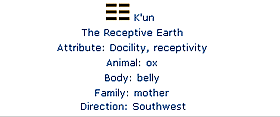
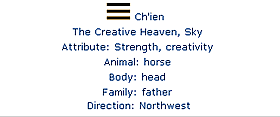
The Receptive, which moves downward, stands above; the Creative, which moves upward, is below. Hence their influences meet and are in harmony, so that all living things bloom and prosper. This hexagram belongs to the first month (February-March), at which time the forces of nature prepare the new spring.
THE JUDGMENT
PEACE. The small departs, The great approaches. Good fortune. Success.
This hexagram denotes a time in nature when heaven seems to be on earth. Heaven has placed itself beneath the earth, and so their powers unite in deep harmony. Then peace and blessing descend upon all living things. In the world of man it is a time of social harmony; those in high places show favor to the lowly, and the lowly and inferior is an end to all feuds. In side, at the center, in the key position, is the light principle; the dark principle is outside. Thus the light has a powerful influence, while the dark is submissive. In this way each receives its due. When the good elements of society occupy a central position and are in control, the evil elements come under their influence and change for the better. When the spirit of heaven rules in man, his animal nature also comes under its influence and takes its appropriate place. The individual lines enter the hexagram from below and leave it again at the top. Here the small, weak, and evil elements are about to take their departure, while the great, strong, and good elements are moving up. This brings good fortune and success.
THE IMAGE
Heaven and earth unite: the image of PEACE. Thus the ruler Divides and completes the course of heaven and earth, And so aids the people.
Heaven and earth are in contact and combine their influences, producing a time of universal flowering and prosperity. This stream of energy must be regulated by the ruler of men. It is done by a process of division. Thus men divide the uniform flow of time into the seasons, according to the succession of natural phenomena, and mark off infinite space by the points of the compass. In this way nature in its overwhelming profusion of phenomena is bounded and controlled. One the other hand, nature must be furthered in her productiveness. This is done by adjusting the products to the right time and the right place, which increases the natural yield. This controlling and furthering activity of man in his relation to nature is the work on nature that rewards him.
THE LINES Nine at the beginning means: When ribbon grass is pulled up, the sod comes with it. Each according to his kind. Undertakings bring good fortune.
In times of prosperity every able man called to fill an office draws like minded people along with him, just as in pulling up ribbon grass one always pulls up a bunch of it, because the stalks are connected by their roots. In such times, when it is possible to extend influence widely, the mind of an able man is set upon going out into life and accomplishing something.
 Nine in the second place means: Bearing with the uncultured in gentleness,
Fording the river with resolution,
Not neglecting what is distant,
Not regarding one's companions:
Thus one may manage to walk in the middle.
Nine in the second place means: Bearing with the uncultured in gentleness,
Fording the river with resolution,
Not neglecting what is distant,
Not regarding one's companions:
Thus one may manage to walk in the middle.
In times of prosperity it is important and above all to possess enough greatness of soul to bear with imperfect people. For in the hands of a great master no material is unproductive; he can find use for everything. But this generosity is by no means laxity or weakness. It is during times of prosperity especially that we must always be ready to risk even dangerous undertakings, such as the crossing of a river, if they are necessary. So too we must not neglect what is distant but must attend scrupulously to everything. Factionalism and the dominance of cliques are especially to be avoided. Even if people of like mind come forward together, they ought not to form a faction by holding together for mutual advantage; instead, each man should do is duty. Theses are four ways in which one can overcome the hidden danger of a gradual slackening that always lurks in any time of peace. And that is how one finds the middle way for action.
Nine in the third place means: No plain not followed by a slope. No going not followed by a return. He who remains persevering in danger Is without blame. Do not complain about this truth; Enjoy the good fortune you still possess. Everything on earth is subject to change. Prosperity is followed by decline: this is the eternal law on earth. Evil can indeed be held in check but not permanently abolished. It always returns. This conviction might induct melancholy, but it should not; it ought only to keep us from falling into illusion when good fortune comes to us. If we continue mindful of the danger, we remain persevering and make no mistakes. As long as a man's inner nature remains stronger and richer than anything offered by external fortune, as long as he remains inwardly superior to fate, fortune will not desert him.
Six in the fourth place means: He flutters down, not boasting of his wealth, Together with his neighbor, Guileless and sincere.
In times of mutual confidence, people of high rank come in close contact with the lowly quite simply and without boasting of their wealth. This is not due to the force of circumstances but corresponds with their inmost sentiment. The approach is made quite spontaneously, because it is based on inner conviction.
Six in the fifth place means: The sovereign I
Gives his daughter in marriage.
And supreme good fortune.
The sovereign I is T'ang the Completer. By his decree the imperial princesses, although higher in rank than their husbands, had to obey them like all other wives. Here too we are shown a truly modest union of high and low that brings happiness and blessings.
Six at the top means: The wall falls back into the moat. Use no army now. Make your commands known within your own town. Perseverance brings humiliation.
The change alluded to in the middle of the hexagram has begun to take place. The wall of the town sinks back into the moat from which it was dug. The hour of doom is at hand. When matters have come to this pass, we should submit to fate and not try to stave it off by violent resistance. The one recourse left us is to hold our own within our intimate circle. Should we persevere in trying to resist the evil in the usual way, our collapse would only be more complete, and humiliation would be the result.