The Chinese character ku represents a bowl in whose contents worms are breeding. This means decay. IT is come about because the gentle indifference in the lower trigram has come together with the rigid inertia of the upper, and the result is stagnation. Since this implies guilt, the conditions embody a demand for removal of the cause. Hence the meaning of the hexagram is not simply "what has been spoiled" but "work on what has been spoiled". THE JUDGMENT
WORK ON WHAT HAS BEEN SPOILED Has supreme success. It furthers one to cross the great water. Before the starting point, three days. After the starting point, three days.
What has been spoiled through man's fault can be made good again through man's work. IT is not immutable fate, as in the time of STANDSTILL, that has caused the state of corruption, but rather the abuse of human freedom. Work toward improving conditions promises well, because it accords the possibilities of the time. We must not recoil from work and danger- symbolized by crossing of the great water-but must take hold energetically. Success depends, however, on proper deliberation. This is expressed by the lines, "Before the starting point, three days. After the starting point, three days." We must first know the cause of corruption before we can do away with them; hence it is necessary to be cautious during the time before the start. Then we must see to it that the new way is safely entered upon, so that a relapse may be avoided; therefore we must pay attention to the time after the start. Decisiveness and energy must take the place of inertia and indifference that have led to decay, in order that the ending may be followed by a new beginning.
THE IMAGE
The wind blows low on the mountain: The image of DECAY. Thus the superior man stirs up the people And strengthens their spirit.
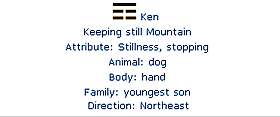
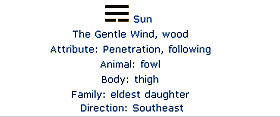
When the wind blow s slow on the mountain, it is thrown back and spoils the vegetation. This contains a challenge to improvement. It is the same with debasing attitudes and fashions; they corrupt human society. His methods likewise must be derived from the two trigrams, but in such a way that their effects unfold in orderly sequence. The superior must first remove stagnation by stirring up public opinion, as the wind stirs up everything, and must strengthen and tranquilize the character of the people, as the mountain gives tranquillity and nourishment to all that grows in its vicinity.
THE LINES
Six in the beginning means: Setting right what has been spoiled by the father. If there is a son, No blame rests upon the departed father. Danger. In the end good fortune.
Rigid adherence to tradition has resulted in decay. But the decay has not yet penetrated deeply and so can still be easily remedied. It is as if a son were compensated for the decay his father allowed to creep in. Then no blame attaches to the father. However, one must not overlook the danger or take the matter too lightly. Only if one is conscious of the danger connected with every reform will everything go well in the end.
Nine in the second place means: Setting right what has been spoiled by the mother. One must not be too persevering. This refers to mistakes that as a result of weakness have brought about decay- hence the symbol, "what has been spoiled by the mother. " In setting things right in such a case, a certain gentle consideration is called for. In order not to wound, one should not attempt to proceed too drastically. Nine in the third place means: Setting right what has been spoiled by the father. There will be a little remorse. No great blame.
This describes a man who proceeds a little too energetically in righting the mistakes of the past. Now and then, as a result, minor discourse and annoyances will surely develop. But too much energy is better than too little. Therefore, although he may at times have slight cause for regret, he remains free of any serious blame.
Six in the fourth place means: Tolerating what has been spoiled by the father. In continuing one sees humiliation. This shows the situation of someone too weak to take measures against decay that has its roots in the past and is just beginning to manifest itself. It is allowed to run its course. If this continues, humiliation will result.
 Six in the fifth place means:
Setting right what has been spoiled by the father.
One meets with praise.
Six in the fifth place means:
Setting right what has been spoiled by the father.
One meets with praise.
An individual is confronted with corruption originating from neglect in former times. He lacks the power to ward it off alone, but with able helpers he can at least bring about a thorough reform, if he cannot create a new beginning, and this also is praiseworthy.
Nine at the top means: He does not serve kings and princes, Sets himself higher goals. Not every man has an obligation to mingle in the affairs of the world. There are some who are developed to such a degree that they are justified in letting the world go its own way and refusing to enter public life with a view to reforming it. But this does not imply a right to remain idle or to sit back and merely criticize. Such withdrawal is justified only when we strive to realize in ourselves the higher aims of mankind. For although the sage remains distant from the turmoil of daily life, he creates incomparable human values for the future.