The idea of a turning point arises from the fact that after the dark lines have pushed all of the light lines upward and out of the hexagram, another light line enters the hexagram from below. The time of darkness is past. The winter solstice brings the victory of light. This hexagram is linked with the eleventh month, the month of the solstice (December-January).
THE JUDGMENT
RETURN. Success. Going out and coming in without error. Friends come without blame. To and fro goes the way. On the seventh day comes return. It furthers one to have somewhere to go.
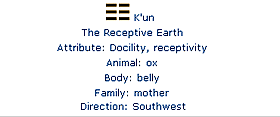
After a time of decay comes the turning point. The powerful light that has been banished returns. There is movement, but it is not brought about by force. The upper trigram K'un is characterized by devotion; thus the movement is natural, arising spontaneously. For this reason the transformation of the old becomes easy. The old is discarded and the new is introduced. Both measures accord with the time; therefore no harm results. Societies of people sharing the same views are formed. But since these groups come together in full public knowledge and are in harmony with the time, all selfish separatist tendencies are excluded, and no mistake is made. The idea of RETURN is based on the course of nature. The movement is cyclic, and the course completes itself. Therefore it is not necessary to hasten anything artificially. Everything comes of itself at the appointed time. This is the meaning of heaven and earth. All movements are accomplished in six stages, and the seventh brings return. Thus the winter solstice, with which the decline of the year begins, comes in the seventh month after the summer solstice; so too sunrise comes in the seventh double hour after sunset. Therefore seven is the number of the young light, and it arises when six, the number of the great darkness, is increased by one. In this way the state of rest gives place to movement.
THE IMAGE
Thunder within the earth: The image of THE TURNING POINT. Thus the kings of antiquity closed the passes At the time of solstice. Merchants and strangers did not go about, And the ruler Did not travel through the provinces.
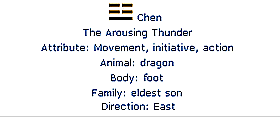
The winter solstice has always been celebrated in China as the resting time of the year--a custom that survives in the time of rest observed at the new year. In winter the life energy, symbolized by thunder, the Arousing, is still underground. Movement is just at its beginning; therefore it must be strengthened by rest so that it will not be dissipated by being used prematurely. This principle, i.e., of allowing energy that is renewing itself to be reinforced by rest, applies to all similar situations. The return of health after illness, the return of understanding after an estrangement: everything must be treated tenderly and with care at the beginning, so that the return may lead to a flowering.
THE LINES
 Nine at the beginning means:
Return from a short distance.
No need for remorse.
Great good fortune.
Nine at the beginning means:
Return from a short distance.
No need for remorse.
Great good fortune.
Slight digressions from the good cannot be avoided, but one must turn back in time, before going too far. This is especially important in the development of character; every faintly evil thought must be put aside immediately, before it goes too far and takes root in the mind. Then there is no cause for remorse, and all goes well.
Six in the second place means: Quiet return. Good fortune.
Return always calls for a decision and is an act of self-mastery. It is made easier if a man is in good company. If he can bring himself to put aside pride and follow the example of good men, good fortune results.
Six in the third place means: Repeated return. Danger. No blame.
There are people of a certain inner instability who feel a constant urge to reverse themselves. There is danger in continually deserting the good because of uncontrolled desires, then turning back to it again because of a better resolution. However, since this does not lead to habituation in evil, a general inclination to overcome the defect is not wholly excluded/
Six in the fourth place means: Walking in the midst of others, One returns alone.
A man is in a society composed of inferior people, but is connected spiritually with a strong and good friend, and this makes him turn back alone. Although nothing is said of reward and punishment, this return is certainly favorable, for such a resolve to choose the good brings its own reward. Six in the fifth place means: Noblehearted return. No remorse.
When the time for return has come, a man should not take shelter in trivial excuses, but should look within and examine himself. And if he has done something wrong he should make a noblehearted resolve to confess his fault. No one will regret having taken this road.
Six at the top means: Missing the return. Misfortune. Misfortune from within and without. If armies are set marching in this way, One will in the end suffer a great defeat, Disastrous for the ruler of the country. For ten years It will not be possible to attack again.
If a man misses the right time for return, he meets with misfortune. The misfortune has its inner cause in a wrong attitude toward the world. The misfortune coming upon him for without results from this wrong attitude. What is pictured here is blind obstinacy and the judgment that is visited upon it.