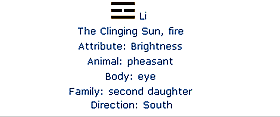
This hexagram is another double sign. The trigram Li means "to cling to something," and also "brightness." A dark line clings to two light lines, one above and one below--the image of an empty space between two strong lines, whereby the two strong lines are made bright. The trigram represents the middle daughter. The Creative has incorporated the central line of the Receptive, and thus Li develops. As an image, it is fire. Fire has no definite form but clings to the burning object and thus is bright. As water pours down from heaven, so fire flames up from the earth. While K'an means the soul shut within the body, Li stands for nature in its radiance.
THE JUDGMENT
THE CLINGING. Perseverance furthers. It brings success. Care of the cow brings good fortune.
What is dark clings to what is light and so enhances the brightness of the latter. A luminous thing giving out light must have within itself something that perseveres; otherwise it will in time burn itself out. Everything that gives light is dependent on something to which it clings, in order that it may continue to shine. Thus the sun and moon cling to heaven, and grain, grass, and trees cling to the earth. So too the twofold clarity of the dedicated man clings to what is right and thereby can shape the world. Human life on earth is conditioned and unfree, and when man recognizes this limitation and makes himself dependent upon the harmonious and beneficent forces of the cosmos, he achieves success. The cow is the symbol of extreme docility. By cultivating in himself an attitude of compliance and voluntary dependence, man acquires clarity without sharpness and finds his place in the world.
THE IMAGE
That which is bright rises twice: The image of FIRE. Thus the great man, by perpetuating this brightness, Illumines the four quarters of the world.
Each of the two trigrams represents the sun in the course of a day. The two together represent the repeated movement of the sun, the function of light with respect to time. The great man continues the work of nature in the human world. Through the clarity of his nature he causes the light to spread farther and farther and to penetrate the nature of man ever more deeply. THE LINES Nine at the beginning means: The footprints run crisscross. If one is seriously intent, no blame.
It is early morning and work begins. The mind has been closed to the outside world in sleep; now its connections with the world begin again. The traces of one's impressions run crisscross. Activity and haste prevail. It is important then to preserve inner composure and not to allow oneself to be swept along by the bustle of life. If one is serious and composed, he can acquire the clarity of mind needed for coming to terms with the innumerable impressions that pour in. It is precisely at the beginning that serious concentration is important, because the beginning holds the seed of all that is to follow.
 Six in the second place means:
Yellow light. Supreme good fortune.
Six in the second place means:
Yellow light. Supreme good fortune.
Midday has come; the sun shines with a yellow light. Yellow is the color of measure and mean. Yellow light is therefore a symbol of the highest culture and art, whose consummate harmony consists in holding to the mean.
Nine in the third place means: In the light of the setting sun, Men either beat the pot and sing Or loudly bewail the approach of old age. Misfortune.
Here the end of the day has come. The light of the setting sun calls to mind the fact that life is transitory and conditional. Caught in this external bondage, men are usually robbed of their inner freedom as well. The sense of the transitoriness of life impels them to uninhibited revelry in order to enjoy life while it lasts, or else they yield to melancholy and spoil the precious time by lamenting the approach of old age. Both attitudes are wrong. To the superior man it makes no difference whether death comes early or late. He cultivates himself, awaits his allotted time, and in this way secures his fate.
Nine in the fourth place means: Its coming is sudden; It flames up, dies down, is thrown away.
Clarity of mind has the same relation to life that fire has to wood. Fire clings to wood, but also consumes it. Clarity of mind is rooted in life but can also consume it. Everything depends upon how the clarity functions. Here the image used is that of a meteor or a straw fire. A man who is excitable and restless may rise quickly to prominence but produces no lasting effects. Thus matters end badly when a man spends himself too rapidly and consumes himself like a meteor.
Six in the fifth place means:
Tears in floods, sighing and lamenting.
Good fortune.
Here the zenith of life has been reached. Were there no warning, one would at this point consume oneself like a flame. Instead, understanding the vanity of all things, one may put aside both hope and fear, and sigh and lament: if one is intent on retaining his clarity of mind, good fortune will come from this grief. For here we are dealing not with a passing mood, as in the Nine in the third place, but with a real change of heart.
Nine at the top means: The king used him to march forth and chastise. Then it is best to kill the leaders And take captive the followers. No blame.
It is not the purpose of chastisement to impose punishment blindly but to create discipline. Evil must be cured at its roots. To eradicate evil in political life, it is best to kill the ringleaders and spare the followers. In educating oneself it is best to root out bad habits and tolerate those that are harmless. For asceticism that is too strict, like sentences of undue severity, fails in its purpose.