The power of the dark is ascending. The light retreats to security, so that the dark cannot encroach upon it. This retreat is a matter not of man's will but of natural law. Therefore in this case withdrawal is proper; it is the correct way to behave in order not to exhaust one's forces. In the calendar this hexagram is linked with the sixth month (July-August), in which the forces of winter are already showing their influence.
THE JUDGMENT
RETREAT. Success. In what is small, perseverance furthers.
Conditions are such that the hostile forces favored by the time are advancing. In this case retreat is the right course, and it is not to be confused with flight. Flight means saving oneself under any circumstances, whereas retreat is a sign of strength. We must be careful not to miss the right moment while we are in full possession of power and position. Then we shall be able to interpret the signs of the time before it is too late and to prepare for provisional retreat instead of being drawn into a desperate life-and-death struggle. Thus we do not simple abandon the field to the opponent; we make it difficult for him to advance by showing perseverance in single acts of resistance. In this way we prepare, while retreating, for the counter- movement. Understanding the laws of a constructive retreat of this sort is not easy. The meaning that lies hidden in such a time is important.
THE IMAGE
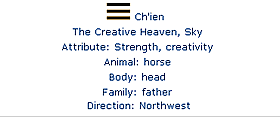
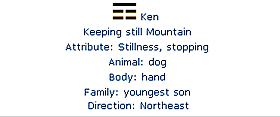
Mountain under heaven: the image of RETREAT. Thus the superior man keeps the inferior man at a distance, Not angrily but with reserve.
The mountain rises up under heaven, but owing to its nature it finally comes to a stop. Heaven on the other hand retreats upward before it into the distance and remains out of reach. This symbolizes the behavior of the superior man toward a climbing inferior; he retreats into his own thoughts as the inferior man comes forward. He does not hate him, for hatred is a form of subjective involvement by which we are bound to the hated object. The superior man shows strength (heaven) in that he brings the inferior man to a standstill (mountain) by his dignified reserve.
THE LINES
 Six at the beginning means:
At the tail in retreat. This is dangerous.
One must not wish to undertake anything.
Six at the beginning means:
At the tail in retreat. This is dangerous.
One must not wish to undertake anything.
Since the hexagram is the picture of something that is retreating, the lowest line represents the tail and the top line the head. In a retreat it is advantageous to be at the front. Here one is at the back, in immediate contact with the pursuing enemy. This is dangerous, and under such circumstances it is not advisable to undertake anything. Keeping still is the easiest way of escaping from the threatening danger.
Six in the second place means: he holds him fast with yellow oxhide. No one can tear him loose.
Yellow is the color of the middle. It indicates that which is correct and in line with duty. Oxhide is strong and not to be torn. While the superior men retreat and the inferior press after them, the inferior man represented here holds on so firmly and tightly to the superior man that the latter cannot shake him off. And because he is in quest of what is right an so strong in purpose, he reaches his goal. Thus the line confirms what is said in the Judgment: "In what is small" --here equivalent to "in the inferior man" -- "perseverance furthers."
Nine in the third place means: A halted retreat Is nerve-wracking and dangerous. To retain people as men- and maidservants Brings good fortune.
When it is time to retreat it is both unpleasant and dangerous to be held back, because then one no longer has freedom of action. In such a case the only expedient is to take into one's service, so to speak, those who refuse to let one go, so that one may at least keep one's initiative and not fall helplessly under their domination. But even with this expedient the situation is far from satisfactory--for what can one hope to accomplish with such servants?
Nine in the fourth place means: Voluntary retreat brings good fortune to the superior man And downfall to the inferior man.
In retreating the superior man is intent on taking his departure willingly and in all friendliness. He easily adjusts his mind to retreat, because in retreating he does not have to do violence to his convictions. The only one who suffers is the inferior man from whom he retreats, who will degenerate when deprived of the guidance of the superior man.
Nine in the fifth place means:
Friendly retreat. Perseverance brings good fortune.
It is the business of the superior man to recognize in time that the moment for retreat has come. If the right moment is chosen, the retreat can be carried out within the forms of perfect friendliness, without the necessity of disagreeable discussions. Yet, for all the observance of amenities, absolute firmness of decision is necessary if one is not to be led astray by irrelevant considerations.
Nine at the top means: Cheerful retreat. Everything serves to further.
The situation is unequivocal. Inner detachment has become an established fact, and we are at liberty to depart. When one sees the way ahead thus clearly, free of all doubt, a cheerful mood sets in, and one chooses what is right without further thought. Such a clear path ahead always leads to the good.