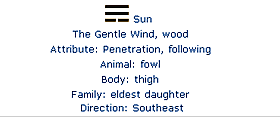
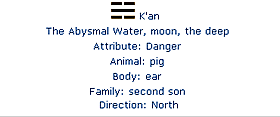
Wind blowing over water disperses it, dissolving it into foam and mist. This suggests that when a man's vital energy is dammed up within him (indicated as a danger by the attribute of the lower trigram), gentleness serves to break up and dissolve the blockage.
THE JUDGMENT
DISPERSION. Success. The king approaches his temple. It furthers one to cross the great water. Perseverance furthers.
The text of this hexagram resembles that of Ts'ui, GATHERING TOGETHER (45). In the latter, the subject is the bringing together of elements that have been separated, as water collects in lakes upon the earth. Here the subject is the dispersing and dissolving of divisive egotism. DISPERSION shows the way, so to speak, that leads to gathering together. This explains the similarity of the two texts. Religious forces are needed to overcome the egotism that divides men. The common celebration of the great sacrificial feasts and sacred rites, which gave expression simultaneously to the interrelation and social articulation of the family and state, was the means of employed by the great ruler to unite men. The sacred music and the splendor of the ceremonies aroused a strong tide of emotion that was shared by all hearts in unison, and that awakened a consciousness of the common origin of all creatures. In this way disunity was overcome and rigidity dissolved. A further means to the same end is co- operation in great general undertakings that set a high goal for the will of the people; in the common concentration on this goal, all barriers dissolve, just as, when a boat is crossing a great stream, all hands must unite in a joint task. But only a man who is himself free of all selfish ulterior considerations, and who perseveres in justice and steadfastness, is capable of so dissolving the hardness of egotism.
THE IMAGE
The wind drives over the water: The image of DISPERSION. Thus the kings of old sacrificed to the Lord And built temples.
In the autumn and winter, water begins to freeze into ice. When the warm breezes of spring come, the rigidity is dissolved, and the elements that have been dispersed in ice floes are reunited. It is the same with the minds of the people. Through hardness and selfishness the heart grows rigid, and this rigidity leads to separation from all others. Egotism and cupidity isolate men. Therefore the hearts of men must be seized by a devout emotion. They must be shaken by a religious awe in face of eternity-stirred with an intuition of the One Creator of all living beings, and united through the strong feeling of fellowship experienced in the ritual of divine worship.
THE LINES
Six at the beginning means: He brings help with the strength of a horse. Good fortune.
It is important that disunion should be overcome at the outset, before it has become complete-that the clouds should be dispersed before they have brought storm and rain. At such times when hidden divergences in temper make themselves felt and lead to mutual misunderstandings we must take quick and vigorous action to dissolve the misunderstandings and mutual distrust.
Nine in the second place means: At the dissolution He hurries to that which supports him. Remorse disappears.
When an individual discovers within himself the beginnings of alienation from others, of misanthropy and ill humor, he must set about dissolving these obstructions. He must rouse himself inwardly, hasten to that which supports him. Such support is never found in hatred, but always in a moderate and just judgment of men, linked with good will. If he regains this unobstructed outlook on humanity, while at the same time all saturnine ill humor is dissolved, all occasion for remorse disappears.
Six in the third place means: He dissolves his self. No remorse.
Under certain circumstances, a man's work may become so difficult that he can no longer think of himself. He must set aside all personal desires and disperse whatever the self gathers about it to serve as a barrier against others. Only on the basis of great renunciation can he obtain the strength for great achievements. By setting his goal in a great task outside himself, he can attain this standpoint.
Six in the fourth place means: He dissolves his bond with his group. Supreme good fortune. Dispersion leads in turn to accumulation. This is something that ordinary men do not think of.
When we are working at a task that affects the general welfare, we must leave all private friendships out of account. Only by rising above party interests can we achieve something decisive. He who has the courage thus to forego what is near wins what is afar. But in order to comprehend this standpoint, one must have a wide view of the interrelationships of life, such as only unusual men attain.
 Nine in the fifth place means: His loud cries are as dissolving
as sweat. Dissolution! A king abides without blame.
Nine in the fifth place means: His loud cries are as dissolving
as sweat. Dissolution! A king abides without blame.
In times of general dispersion and separation, a great idea provides a focal point for the organization of recovery. Just as an illness reaches its crisis in a dissolving sweat, so a great stimulating idea is a true salvation in times of general deadlock. It gives the people a rallying point-a man in a ruling position who can dispel misunderstandings. Nine at the top means: He dissolves his blood. Departing, keeping at a distance, going out, Is without blame.
The idea of the dissolving of a man's blood means the dispersion of that which might lead to bloodshed and wounds, i.e., avoidance of danger. But here the thought is not that a man avoids difficulties for himself alone, but rather that he rescues his kin-helps them to get away before danger comes, or to keep at a distance from an existing danger, or to find a way out of a danger that is already upon them. In this way he does what is right.