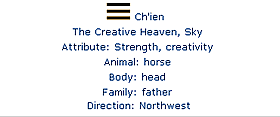
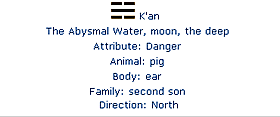
The upper trigram, whose image is heaven, has an upward movement; the lower trigram, water, in accordance with its nature tends downward. Thus the two halves move away from each other, giving rise to the idea of conflict. The attribute of the Creative is strength, that of the Abysmal is danger, guile. Where cunning has force before it, there is conflict. A third indication of conflict, in terms of character, is presented by the combination of deep cunning within and fixed determination outwardly. A person of this character will certainly be quarrelsome.
THE JUDGMENT
CONFLICT. You are sincere And are being obstructed. A cautious halt halfway brings good fortune. Going through to the end brings misfortune. It furthers one to see the great man. It does not further one to cross the great water.
Conflict develops when one feels himself to be in the right and runs into opposition. If one is not convinced of being in the right, opposition leads to craftiness or high-handed encroachment but not to open conflict. If a man is entangled in a conflict, his only salvation lies in being so clear- headed and inwardly strong that he is always ready to come to terms by meeting the opponent halfway. To carry one the conflict to the bitter end has evil effects even when one is the right, because the enmity is then perpetuated. It is important to see the great man, that is, an impartial man whose authority is great enough to terminate the conflict amicably or assure a just decision. In times of strife, crossing the great water is to be avoided, that is, dangerous enterprises are not to be begun, because in order to be successful they require concerted unity of focus. Conflict within weakens the power to conquer danger without.
THE IMAGE
Heaven and water go their opposite ways: The image of CONFLICT. Thus in all his transactions the superior man Carefully considers the beginning.
The image indicates that the causes of conflict are latent in the opposing tendencies of the two trig rams. Once these opposing tendencies appear, conflict is inevitable. To avoid it, therefore, everything must be taken carefully into consideration in the very beginning. If rights and duties are exactly defined, or if, in a group, the spiritual trends of the individuals harmonize, the cause of conflict is removed in advance.
THE LINES
Six at the beginning means: If one does not perpetuate the affair, There is a little gossip. In the end, good fortune comes.
While a conflict is in the incipient stage, the best thing To do is to drop the issue. Especially when the adversary is stronger, it is not advisable to risk pushing the conflict to a decision. It may come to a slight dispute, but in the end all goes well.
Nine in the second place means: One cannot engage in conflict; One returns home, gives way. The people of his town, Three hundred households, Remain free of guilt.
In a struggle with an enemy of superior strength, retreat is no disgrace. Timely withdrawal prevents bad consequences. If, out of a false sense of honor, a man allowed himself to be tempted into an unequal conflict, he would be drawing down disaster upon himself. In such a case a wise and conciliatory attitude benefits the whole community, which will then not be drawn into the conflict. Six in the third place means: To nourish oneself on ancient virtue induces perseverance. Danger. In the end, good fortune comes. If by chance you are in the service of a king, Seek not works.
This is a warning of the danger that goes with an expansive disposition. Only that which has been honestly acquired through merit remains a permanent possession. It can happen that such a possession may be contested, but since it is really one's own, one cannot be robbed of it. Whatever a man possesses through the strength of his own nature cannot be lost. If one enters the service of a superior, one can avoid conflict only by not seeking works for the sake of prestige. It is enough if the work is done: let the honor go to the other.
Nine in the fourth place means: One cannot engage in conflict. One turns back and submits to fate, Changes one's attitude, And finds peace in perseverance. Good fortune.
This refers to a person whose inner attitude at first lacks peace. He does not feel content with his situation and would like to improve it through conflict. In contrast tot the situation of the Nine in the second place, he is dealing with a weaker opponent and might therefore succeed. But he cannot carry on the fight, because, since right is not on his side, he cannot justify the conflict to his conscience. Therefore he turns back and accepts his fate. He changes his mind and finds lasting peace in being at one with eternal law. This brings good fortune.
 Nine in the fifth place means:
To contend before him
Brings supreme good fortune.
Nine in the fifth place means:
To contend before him
Brings supreme good fortune.
This refers to an arbiter in a conflict who is powerful and just, and strong enough to lend weight to the right side. A dispute can be turned over to him with confidence. If one is in the right, one attains great good fortune.
Nine at the top means: Even if by chance a leather belt is bestowed on one,' By the end of a morning It will have been snatched away three times.
Here we have someone who has carried a conflict to the bitter end and has triumphed. He is granted a decoration, but his happiness does not last. He is attacked again and again, and the result is conflict without end.
index