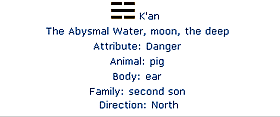
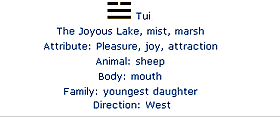
A lake occupies a limited space. When more water comes into it, it overflows. Therefore limits must be set for the water. The image shows water below and water above, with the firmament between them as a limit. The Chinese word for limitation really denotes the joints that divide a bamboo stalk. In relation to ordinary life it means the thrift that sets fixed limits upon expenditures. In relation to the moral sphere it means the fixed limits that the superior man sets upon his actions-the limits of loyalty and disinterestedness.
THE JUDGMENT
LIMITATION. Success. Galling limitation must not be persevered in.
Limitations are troublesome, but they are effective. If we live economically in normal times, we are prepared for times of want. To be sparing saves us from humiliation. Limitations are also indispensable in the regulation of world conditions. In nature there are fixed limits for summer and winter, day and night, and these limits give the year its meaning. In the same way, economy, by setting fixed limits upon expenditures, acts to preserve property and prevent injury to the people. But in limitation we must observe due measure. If a man should seek to impose galling limitations upon his own nature, it would be injurious. And if he should go too far in imposing limitations on others, they would rebel. Therefore it is necessary to set limits even upon limitation.
THE IMAGE
Water over lake: the image of LIMITATION. Thus the superior man Creates number and measure, And examines the nature of virtue and correct conduct.
A lake is something limited. Water is inexhaustible. A lake can contain only a definite amount of the infinite quantity of water; this is its peculiarity. In human life too the individual achieves significance through discrimination and the setting of limits. Therefore what concerns us here is the problem of clearly defining these discriminations, which are, so to speak, the backbone of morality. Unlimited possibilities are not suited to man; if they existed, his life would only dissolve in the boundless. To become strong, a man's life needs the limitations ordained by duty and voluntarily accepted. The individual attains significance as a free spirit only by surrounding himself with these limitations and by determining for himself what his duty is.
THE LINES
Nine at the beginning means: Not going out of the door and the courtyard Is without blame.
Often a man who would like to undertake something finds himself confronted by insurmountable limitations. Then he must know where to stop. If he rightly understands this and does not go beyond the limits set for him, he accumulates an energy that enables him, when the proper time comes, to act with great force. Discretion is of prime importance in preparing the way for momentous things. Concerning this, Confucius says:
Where disorder develops, words are the first steps. If the prince is not discreet, he loses his servant. If the servant is not discreet he loses his life. If germinating things are not handled with discretion, the perfecting of them is impeded. Therefore the superior man is careful to maintain silence and does not go forth.
Nine in the second place means: Not going out of the gate and the courtyard Brings misfortune.
When the time for action has come, the moment must be quickly seized. Just as water first collects in a lake without flowing out, yet is certain to find an outlet when the lake is full, so it is in the life of man. It is a good thing to hesitate so long as the time for action has not come, but no longer. Once the obstacles to action have been removed, anxious hesitation is a mistake that is bound to bring disaster, because one misses one's opportunity.
Six in the third place means: He who knows limitation Will have cause to lament. No blame.
If an individual is bent only on pleasures and enjoyment, it is easy for him to lose his sense of the limits that are necessary. If he gives himself over to extravagance, he will have to suffer the consequences, with accompanying regret. He must not seek to lay the blame on others. Only when we realize that our mistakes are of our own making will such disagreeable experiences free us of errors.
Six in the fourth place means: Contented limitation. Success.
Every limitation has its value, but a limitation that requires persistent effort entails a cost of too much energy. When, however, the limitation is a natural one (as for example, the limitation by which water flows only downhill), it necessarily leads to success, for then it means a saving of energy. The energy that otherwise would be consumed in a vain struggle with the object, is applied wholly to the benefit of the matter in hand, and success is assured.
 Nine in the fifth place means:
Sweet limitation brings good fortune.
Going brings esteem.
The limitation must be carried out in the right way if it is to
be effective. If we
seek to impose restrictions on others only, while evading them ourselves,
these restrictions will always be resented and will provoke resistance.
If,
however, a man in a leading position applies the limitation first
to himself,
demanding little from those associated with him, and with modest
means
manages to achieve something, good fortune is the result. Where
such an
example occurs, it meets with emulation, so that whatever is undertaken
must succeed.
Nine in the fifth place means:
Sweet limitation brings good fortune.
Going brings esteem.
The limitation must be carried out in the right way if it is to
be effective. If we
seek to impose restrictions on others only, while evading them ourselves,
these restrictions will always be resented and will provoke resistance.
If,
however, a man in a leading position applies the limitation first
to himself,
demanding little from those associated with him, and with modest
means
manages to achieve something, good fortune is the result. Where
such an
example occurs, it meets with emulation, so that whatever is undertaken
must succeed.
Six at the top means: Galling limitation. Perseverance brings misfortune. Remorse disappears.
If one is too severe in setting up restrictions, people will not endure them. The more consistent such severity, the worse it is, for in the long run a reaction is unavoidable. In the same way, the tormented body will rebel against excessive asceticism. On the other hand, although ruthless severity is not to be applied persistently and systematically, there may be times when it si the only means of safeguarding against guilt and remorse. In such situations ruthlessness toward oneself is the only means of saving one's soul, which otherwise would succumb to irresolution and temptation.