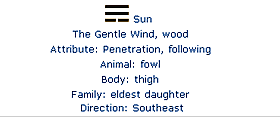
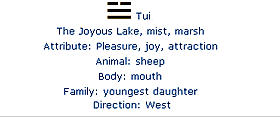
The wind blows over the lake and stirs the surface of the water. Thus visible effects of the invisible manifest themselves. The hexagram consists of firm lines above and below, while it is open in the center. This indicates a heart free of prejudices and therefore open to truth. On the other hand, each of the two trigrams has a firm line in the middle; this indicates the force of inner truth in the influences they present. The attributes of the two trigrams are: above, gentleness, forbearance toward inferiors; below, joyousness in obeying superiors. Such conditions create the basis of a mutual confidence that makes achievements possible. The character of fu ("truth") is actually the picture of a bird's foot over a fledgling. It suggests the idea of brooding. An egg is hollow. The light-giving power must work to quicken it from outside, but there must be a germ of life within, if life is to be awakened. Far-reaching speculations can be linked with these ideas.
THE JUDGMENT
INNER TRUTH. Pigs and fishes. Good fortune. It furthers one to cross the great water. Perseverance furthers.
Pigs and fishes are the least intelligent of all animals and therefore the most difficult to influence. The force of inner truth must grow great indeed before its influence can extend to such creatures. In dealing with persons as intractable and as difficult to influence as a pig or a fish, the whole secret of success depends on finding the right way of approach. One must first rid oneself of all prejudice and, so to speak, let the psyche of the other person act on one without restraint. Then one will establish contact with him, understand and gain power over him. When a door has thus been opened, the force of one's personality will influence him. If in this way one finds no obstacles insurmountable, one can undertake even the most dangerous things, such as crossing the great water, and succeed. But it is important to understand upon what the force inner truth depends. This force is not identical with simple intimacy or a secret bond. Close ties may exist also among thieves; it is true that such a bond acts as a force but, since it is not invincible, it does not bring good fortune. All association on the basis of common interests holds only up to a certain point. Where the community of interest ceases, the holding together ceases also, and the closest friendship often changes into hate. Only when the bond is based on what is right, on steadfastness, will it remain so firm that it triumphs over everything.
THE IMAGE
Wind over lake: the image of INNER TRUTH. Thus the superior man discusses criminal cases In order to delay executions.
Wind stirs water by penetrating it. Thus the superior man, when obliged to judge the mistakes of men, tries to penetrate their minds with understanding, in order to gain a sympathetic appreciation of the circumstances. In ancient China, the entire administration of justice was guided by this principle. A deep understanding that knows how to pardon was considered the highest form of justice. This system was not without success, for its aim was to make so strong a moral impression that there was no reason to fear abuse of such mildness. For it sprang not from weakness but from a superior clarity.
THE LINES
Nine at the beginning means: Being prepared brings good fortune. If there are secret designs, it is disquieting.
The force of inner truth depends chiefly on inner stability and preparedness. From this state of mind springs the correct attitude toward the outer world. But if a man should try to cultivate secret relationships of a special sort, it would deprive him of his inner independence. The more reliance he places on the support of others, the more uneasy and anxious he will become as to whether these secret ties are really tenable. In this way inner peace and the force of inner truth are lost.
Nine in the second place means: A crane calling in the shade. Its young answers it. I have a good goblet. I will share it with you.
This refers to the involuntary influence of a man's inner being upon persons of kindred spirit. The crane need not show itself on a high hill. It may be quite hidden when it sounds its call; yet its young will hear its not, will recognize it and give answer. Where there is a joyous mood, there a comrade will appear to share a glass of wine. This is the echo awakened in men through spiritual attraction. Whenever a feeling is voiced with truth and frankness, whenever a deed is the clear expression of sentiment, a mysterious and far-reaching influence is exerted. At first it acts on those who are inwardly receptive. But the circle grows larger and larger. The root of all influence lies in one's own inner being: given true and vigorous expression in word and deed, its effect is great. The effect is but the reflection of something that emanates from one's own heart. Any deliberate intention of an effect would only destroy the possibility of producing it. Confucius says about this line:
The superior man abides in his room. If his words are well spoken, he meets with assent at a distance of more than a thousand miles. How much more then from near by! If the superior man abides in his room and his words are not well spoken, he meets with contradiction at a distance of more than a thousand miles. How much more then from near by! Words go forth from one's own person and exert their influence on men. Deeds are born close at hand and become visible far away. Words and deeds are the hinge and bowspring of the superior man. As hinge and bowspring move, they bring honor or disgrace. Through words and deeds the superior man moves heaven and earth . Must one not, then, be cautious?
Six in the third place means: He finds a comrade. Now he beats the drum, now he stops. Now he sobs, now he sings.
Here the source of a man's strength lies not in himself but in his relation to other people. No matter how close to them he may be, if his center of gravity depends on them, he is inevitably tossed to and fro between joy and sorrow. Rejoicing to high heaven, then sad unto death-this is the fate of those who depend upon an inner accord with other persons whom they love. Here we have only the statement of the law that this is so. Whether this condition is felt to be an affliction of the supreme happiness of love, is left to the subjective verdict of the person concerned.
Six in the fourth place means: The moon nearly at the full. The team horse goes astray. No blame.
To intensify the power of inner truth, a man must always turn to his superior, from whom he can receive enlightenment as the moon receives light form the sun. However, this requires a certain humility, like that of the moon when it is not yet quite full. At the moment when the moon becomes full and stands directly opposite the sun, it begins to wane. Just as on the one hand we must be humble and reverent when face to face with the source of enlightenment, so likewise must we on the other renounce factionalism among men. Only be pursuing one's course like a horse that goes straight ahead without looking sidewise at its mate, can one retain the inner freedom that helps one onward.
 Nine in the fifth place means:
He possesses truth, which links together.
No blame.
Nine in the fifth place means:
He possesses truth, which links together.
No blame.
This describes the ruler who holds all elements together by the power of his personality. Only when the strength of his character is so ample that he can influence all who are subject to him, is he as he needs to be. The power of suggestion must emanate from the ruler. It will firmly knit together and unite all his adherents. Without this central force, all external unity is only deception and breaks down at the decisive moment.
Nine at the top means: Cockcrow penetrating to heaven. Perseverance brings misfortune.
The cock is dependable. It crows at dawn. But it cannot itself fly to heaven. It just crows. A man may count on mere words to awaken faith. This may succeed now and then, but if persisted in, it will have bad consequences.