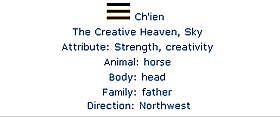
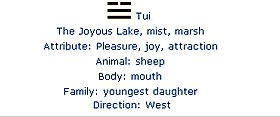
The name of the hexagram means on the one hand the right way of conducting oneself. Heaven, the father, is above, and the lake, the youngest daughter, is below. This shows the difference between high and low, upon which composure correct social conduct, depends. On the other hand the word for the name of the hexagram, TREADING, means literally treading upon something. The small and cheerful [Tui] treads upon the large and strong [Ch'ien]. The direction of movement of the two primary trigrams is upward. The fact that the strong treads on the weak is not mentioned in the Book of Changes, because it is taken for granted. For the weak to take a stand against the strong is not dangerous here, because it happened in good humor [Tui] and without presumption, so that the strong man is not irritated but takes it all in good part.
THE JUDGMENT
TREADING. Treading upon the tail of the tiger. It does not bite the man. Success.
The situation is really difficult. That which is strongest and that which is weakest are close together. The weak follows behind the strong and worries it. The strong, however, acquiesces and does not hurt the weak, because the contact is in goof humor and harmless. In terms of a human situation, one is handling wild, intractable people. In such a case one's purpose will be achieved if one behaves with decorum. Pleasant manners succeed even with irritable people.
THE IMAGE
Heaven above, the lake below: The image of TREADING. Thus the superior man discriminates between high and low, And thereby fortifies the thinking of the people.
Heaven and the lake show a difference of elevation that inheres in the natures of the two, hence no envy arises. Among mankind also there are necessarily differences of elevation; it is impossible to bring about universal equality. But it is important that differences in social rank should not be arbitrary and unjust, for if this occurs, envy and class struggle are the inevitable consequences. If, on the other hand, external differences in rank correspond with differences in inner worth, and if inner worth forms the criterion of external rank, people acquiesce and order reigns in society.
THE LINES Nine at the beginning means: Simple conduct. Progress without blame.
The situation is one in which we are still not bound by any obligations of social intercourse. If our conduct is simple, we remain free of them We can quietly follow our predilections as long as we are content and make not demands on people. The meaning of the hexagram is not standstill but progress. A man finds himself in an altogether inferior position at the start. However, he has the inner strength that guarantees progress. If he can be content with simplicity, he can make progress without blame. When a man is dissatisfied with modest circumstances, he is restless and ambitious and tries to advance, not for the sake of accomplishing anything worth while, but merely in order to escape from lowliness and poverty by dint of his conduct. Once his purpose is achieved, he is certain to become arrogant and luxury-loving. Therefore blame attaches to his progress. On the other hand, a man who is good at his work is content to behave simply. He wishes to make progress in order to accomplish something. When he attains his goal, he does something worth while, an all is well.
Nine in the second place means: Treading a smooth, level course. The perseverance of a dark man Brings good fortune.
The situation of a lonely sage is indicated here. He remains withdrawn from the bustle of life, seeks nothing, asks nothing of anyone, and travels through life unassailed, on a level road. Since he is content and does not challenge fate, he remains free of entanglements.
 Six in the third place means:
A one-eyed man is able to see,
A lame man is able to tread.
He treads on the tail of the tiger.
The tiger bites the man.
Misfortune.
Thus does a warrior act on behalf of his great prince.
Six in the third place means:
A one-eyed man is able to see,
A lame man is able to tread.
He treads on the tail of the tiger.
The tiger bites the man.
Misfortune.
Thus does a warrior act on behalf of his great prince.
A one-eyed man can indeed see, but not enough for clear vision. A lame man can indeed treat, but not enough to make progress. If in spite of such defects a man considers himself strong and consequently exposes himself to danger, he is inviting disaster, for he is undertaking something beyond his strength. This reckless way of plunging ahead, regardless of the adequacy of one's powers, can be justified only in the case of a warrior battling for his prince.
Nine in the fourth place means: He treads on the tail of the tiger. Caution and circumspection Lead ultimately to good fortune.
This text refers to a dangerous enterprise. The inner power to carry it through is there, but this inner power is combined with hesitating caution in one's external attitude. This line contrasts with the preceding line, which is weak within but outwardly presses forward. Here one is sure of ultimate success, which consists in achieving one's purpose, that is, in overcoming danger by going forward.
Nine in the fifth place means:
Resolute conduct.
Perseverance with awareness of danger.
This refers to the ruler of the hexagram as a whole. One sees that one has to be resolute in conduct. But at the same time one must remain conscious of the danger connected with such resoluteness, especially if it is to be persevered in. Only awareness of the danger makes success possible.
Nine at the top means: Look to your conduct and weigh the favorable signs. When everything is fulfilled, supreme good fortune comes.
The work is ended. If we want to know whether good fortune will follow, we must look back upon our conduct and its consequences. If the effects are good, then good fortune is certain. No one knows himself. It is only by the consequences of his actions, by the fruit of his labors, that a man can judge what he is to expect.