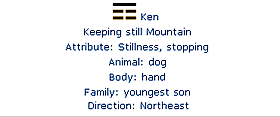
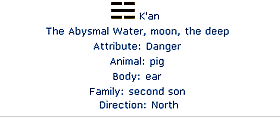
In this hexagram we are reminded of youth and folly in two different ways. The image of the upper trigram, Ken, is the mountain, that of the lower, K'an, is water; the spring rising at the foot of the mountain is the image of inexperienced youth. Keeping still is the attribute of the upper trigram; that of the lower is the abyss, danger. Stopping in perplexity on the brink of a dangerous abyss is a symbol of the folly of youth. However, the two trigrams also show the way of overcoming the follies of youth. Water is something that of necessity flows on. When the spring gushes forth, it does not know at first where it will go. But its steady flow fills up the deep place blocking its progress, and success is attained.
THE JUDGMENT
YOUTHFUL FOLLY has success. It is not I who seek the young fool; The young fool seeks me. At the first oracle I inform him. If he asks two or three times, it is importunity. If he importunes, I give him no information. Perseverance furthers.
In the time of youth, folly is not an evil. One may succeed in spite of it, provided one finds an experienced teacher and has the right attitude toward him. This means, first of all, that the youth himself must be conscious of his lack of experience and must seek out the teacher. Without this modesty and this interest there is no guarantee that he has the necessary receptivity, which should express itself in respectful acceptance of the teacher. This is the reason why the teacher must wait to be sought out instead of offering himself. Only thus can the instruction take place at the right time and in the right way. A teacher's answer to the question of a pupil ought to be clear and definite like that expected from an oracle; thereupon it ought to be accepted as a key for resolution of doubts and a basis for decision. If mistrustful or unintelligent questioning is kept up, it serves only to annoy the teacher. He does well to ignore it in silence, just as the oracle gives one answer only and refuses to be tempted by questions implying doubt. Given addition a perseverance that never slackens until the points are mastered one by one, real success is sure to follow. Thus the hexagram counsels the teacher as well as the pupil.
THE IMAGE
A spring wells up at the foot of the mountain: The image of YOUTH. Thus the superior man fosters his character By thoroughness in all that he does.
A spring succeeds in flowing on and escapes stagnation by filling up all the hollow places in its path. In the same way character is developed by thoroughness that skips nothing but, like water, gradually and steadily fills up all gaps and so flows onward.
THE LINES
Six at the beginning means: To make a fool develop It furthers one to apply discipline. The fetters should be removed. To go on in this way bring humiliation.
Law is the beginning of education. Youth in its inexperience is inclined at first to take everything carelessly and playfully. It must be shown the seriousness of life. A certain measure of taking oneself in hand, brought about by strict discipline, is a good thing. He who plays with life never amounts to anything. However, discipline should not degenerate into drill. Continuous drill has a humiliating effect and cripples a man's powers.
 Nine in the second place means:
To bear with fools in kindliness brings good fortune.
To know how to take women
Brings good fortune.
The son is capable of taking charge of the household.
Nine in the second place means:
To bear with fools in kindliness brings good fortune.
To know how to take women
Brings good fortune.
The son is capable of taking charge of the household.
These lines picture a man who has no external power, but who has enough strength of mind to bear his burden of responsibility. He has the inner superiority and that enable him to tolerate with kindliness the shortcomings of human folly. The same attitude is owed to women as the weaker sex. One must understand them and give them recognition in a spirit of chivalrous consideration. Only this combination of inner strength with outer reserve enables one to take on the responsibility of directing a larger social body with real success.
Six in the third place means: Take not a maiden who. When she sees a man of bronze, Loses possession of herself. Nothing furthers.
A weak, inexperienced man, struggling to rise, easily loses his own individuality when he slavishly imitates a strong personality of higher station. He is like a girl throwing herself away when she meets a strong man. Such a servile approach should not be encouraged, because it is bad both for the youth and the teacher. A girl owes it to her dignity to wait until she is wooed. In both cases it is undignified to offer oneself, and no good comes of accepting such an offer.
Six in the fourth place means: Entangled folly bring humiliation. For youthful folly it is the most hopeless thing to entangle itself in empty imaginings. The more obstinately it clings to such unreal fantasies, the more certainly will humiliation overtake it. Often the teacher, when confronted with such entangled folly, has no other course but to leave the fool to himself for a time, not sparing him the humiliation that results. This is frequently the only means of rescue.
Six in the fifth place means:
Childlike folly brings good fortune.
An inexperienced person who seeks instruction in a childlike and unassuming way is on the right path, for the man devoid of arrogance who subordinated himself to his teacher will certainly be helped.
Nine at the top means: In punishing folly It does not further one To commit transgressions. The only thing that furthers Is to prevent transgressions.
Sometimes an incorrigible fool must be punished. He who will not heed will be made to feel. This punishment is quite different from a preliminary shaking up. But the penalty should not be imposed in anger; it must be restricted to an objective guarding against unjustified excesses. Punishment is never an end in itself but serves merely to restore order. This applies not only in regard to education but also in regard to the measures taken by a government against a populace guilty of transgressions. Governmental interference should always be merely preventive and should have as its sole aim the establishment of public security and peace. index