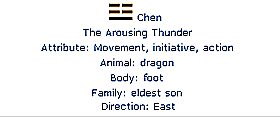
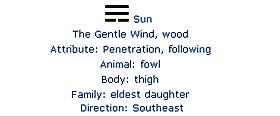
The strong trigram Chen is above, the weak trigram Sun below. This hexagram is the inverse of the preceding one. In the latter we have influence, here we have union as an enduring condition. The two images are thunder and wind, which are likewise constantly paired phenomena. The lower trigram indicates gentleness within; the upper, movement without. In the sphere of social relationships, the hexagram represents the institution of marriage as the enduring union of the sexes. During courtship the young man subordinates himself to the girl, but in marriage, which is represented by the coming together of the eldest son and the eldest daughter, the husband is the directing and moving force outside, while the wife, inside, is gentle and submissive.
THE JUDGMENT
DURATION. Success. No blame. Perseverance furthers. It furthers one to have somewhere to go.
Duration is a state whose movement is not worn down by hindrances. It is not a state of rest, for mere standstill is regression. Duration is rather the self- contained and therefore self-renewing movement of an organized, firmly integrated whole, taking place in accordance with immutable laws and beginning anew at every ending. The end is reached by an inward movement, by inhalation, systole, contraction, and this movement turns into a new beginning, in which the movement is directed outward, in exhalation, diastole, expansion. Heavenly bodies exemplify duration. They move in their fixed orbits, and because of this their light-giving power endures. The seasons of the year follow a fixed law of change and transformation, hence can produce effects that endure. So likewise the dedicated man embodies an enduring meaning in his way of life, and thereby the world is formed. In that which gives things their duration, we can come to understand the nature of all beings in heaven and on earth.
THE IMAGE
Thunder and wind: the image of DURATION. Thus the superior man stands firm And does not change has direction.
Thunder rolls, and the wind blows; both are examples of extreme mobility and so are seemingly the very opposite of duration, but the laws governing their appearance and subsidence, their coming and going, endure. In the same way the independence of the superior man is not based on rigidity and immobility of character. He always keeps abreast of the time and changes with it. What endures is the unswerving directive, the inner law of his being, which determines all his actions.
THE LINES
Six at the beginning means: Seeking duration too hastily brings misfortune persistently. Nothing that would further.
Whatever endures can be created only gradually by long-continued work and careful reflection. In the same sense Lao-tse says: "If we wish to compress something, we must first let it fully expand." He who demands too much at once is acting precipitately, and because he attempts too much, he ends by succeeding in nothing.
 Nine in the second place means: Remorse disappears.
The situation is abnormal. A man's force of character is greater
than the available material power. Thus he might be afraid
of allowing himself to
attempt something beyond his strength. However, since it is the
time of DURATION, it is possible for him to control his inner
strength and so to
avoid excess. Cause for remorse then disappears.
Nine in the second place means: Remorse disappears.
The situation is abnormal. A man's force of character is greater
than the available material power. Thus he might be afraid
of allowing himself to
attempt something beyond his strength. However, since it is the
time of DURATION, it is possible for him to control his inner
strength and so to
avoid excess. Cause for remorse then disappears.
Nine in the third place means: He who does not give duration to his character Meets with disgrace. Persistent humiliation.
If a man remains at the mercy of moods of hope or fear aroused by the outer world, he loses his inner consistency of character. Such inconsistency invariably leads to distressing experiences. These humiliations often come from an unforeseen quarter. Such experiences are not merely effects produced by the external world, but logical consequences evoked by his own nature.
Nine in the fourth place means: No game in the field.
If we are in pursuit of game and want to get a shot at a quarry, we must set about it in the right way. A man who persists in stalking game in a place where there is none may wait forever without finding any. Persistence in search is not enough. What is not sought in the right way is not found.
Six in the fifth place means: Giving duration to one's character through perseverance. This is good fortune for a woman, misfortune for a man.
A woman should follow a man her whole life long, but a man should at all times hold to what is his duty at the given moment. Should he persistently seek to conform to the woman, it would be a mistake for him. Accordingly it is altogether right for a woman to hold conservatively to tradition, but a man must always be flexible and adaptable and allow himself to be guided solely by what his duty requires of him at the moment.
Six at the top means: Restlessness as an enduring condition brings misfortune.
There are people who live in a state of perpetual hurry without ever attaining inner composure. Restlessness not only prevents all thoroughness but actually becomes a danger if it is dominant in places of authority.