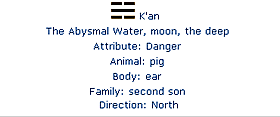
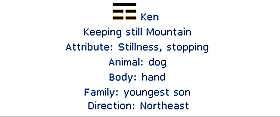
The hexagram pictures a dangerous abyss lying before us and a steep, inaccessible mountain rising behind us. We are surrounded by obstacles; at the same time, since the mountain has the attribute of keeping still, there is implicit a hint as to how we can extricate ourselves. The hexagram represents obstructions that appear in the course of time but that can and should be overcome. Therefore all the instruction given is directed to overcoming them.
THE JUDGMENT
OBSTRUCTION. The southwest furthers. The northeast does not further. It furthers one to see the great man. Perseverance brings good fortune.
The southwest is the region of retreat, the northeast that of advance. Here an individual is confronted by obstacles that cannot be overcome directly. In such a situation it is wise to pause in view of the danger and to retreat. However, this is merely a preparation for overcoming the obstructions. One must join forces with friends of like mind and put himself under the leadership of a man equal to the situation: then one will succeed in removing the obstacles. This requires the will to persevere just when one apparently must do something that leads away from his goal. This unswerving inner purpose brings good fortune in the end. An obstruction that lasts only for a time is useful for self-development. This is the value of adversity. THE IMAGE
Water on the mountain: The image of OBSTRUCTION. Thus the superior man turns his attention to himself And molds his character.
Difficulties and obstructions throw a man back upon himself. While the inferior man seeks to put the blame on other persons, bewailing his fate, the superior man seeks the error within himself, and through this introspection the external obstacle becomes for him an occasion for inner enrichment and education.
THE LINES
Six at the beginning means: Going leads to obstructions, Coming meets with praise.
When one encounters an obstruction, the important thing is to reflect on how best to deal with it. When threatened with danger, one should not strive blindly to go ahead, for this only leads to complications. The correct thing is, on the contrary, to retreat for the time being, not in order to give up the struggle but to await the right moment for action.
Six in the second place means: The King's servant is beset by obstruction upon obstruction, But it is not his own fault.
Ordinarily it is best to go around an obstacle and try to overcome it along the line of least resistance. But there is one instance in which a man must go out to meet the trouble, even though difficulty piles upon difficulty: this is when the path of duty leads directly to it-in other words, when he cannot act of his own volition but is duty bound to go and seek out danger in the service of a higher cause. Then he may do it without compunction, because it is not through any fault of his that he is putting himself in this difficult situation.
Nine in the third place means: Going leads to obstructions; Hence he comes back.
While the preceding line shows the official compelled by duty to follow the way of danger, this line shows the man who must act as father of a family or as head of his kin. If he were to plunge recklessly in to danger, it would be a useless act, because those entrusted to his care cannot get along by themselves. But if he withdraws and turns back to his own, they welcome him with great joy.
Six in the fourth place means: Going leads to obstructions, Coming leads to union.
This too describes a situation that cannot be managed single-handed. In such a case the direct way is not the shortest. If a person were to forge ahead on his own strength and without the necessary preparations, he would not find the support he needs and would realize too late that he has been mistaken in his calculations, inasmuch as the conditions on which he hoped he could rely would prove to be inadequate. In this case it is better, therefore, to hold back for the time being and to gather together trustworthy companions who can be counted upon for help in overcoming the obstructions.
 Nine in the fifth place means:
In the midst of the greatest obstructions,
Friends come.
Nine in the fifth place means:
In the midst of the greatest obstructions,
Friends come.
Here we see a man who is called to help in an emergency. He should not seek to evade the obstructions, no matter how dangerously they pile up before him. But because he is really called to the task, the power of his spirit is strong enough to attract helpers whom he can effectively organize, so that through the well-directed co-operation of all participants the obstruction is overcome.
Six at the top means: Going leads to obstructions, Coming leads to great good fortune. It furthers one to see the great man.
This refers to a man who has already left the world and its tumult behind him. When the time of obstructions arrives, it might seem that the simplest thing for him to do would be to turn his back upon the world and take refuge in the beyond. But this road is barred to him. He must not seek his own salvation and abandon the world to its adversity. Duty calls him back once more into the turmoil of life. Precisely because of his experience and inner freedom, he is able to create something both great and complete that brings good fortune. And it is favorable to see the great man in alliance with whom one can achieve the work of rescue.