This hexagram is the evolution of T'ai PEACE (11). The transition from confusion to order is completed, and everything is in its proper place even in particulars. The strong lines are in the strong places, the weak lines in the weak places. This is a very favorable outlook, yet it gives reason for thought. For it is just when perfect equilibrium has been reached that any movement may cause order to revert to disorder. The one strong line that has moved to the top, thus effecting complete order in details, is followed by the other lines. Each moving according to its nature, and thus suddenly there arises again the hexagram P'i, STANDSTILL (12). Hence the present hexagram indicates the conditions of a time of climax, which necessitate the utmost caution.
THE JUDGMENT
AFTER COMPLETION. Success in small matters. Perseverance furthers. At the beginning good fortune. At the end disorder.
The transition from the old to the new time is already accomplished. In principle, everything stands systematized, and it si only in regard to details that success is still to be achieved. In respect to this, however, we must be careful to maintain the right attitude. Everything proceeds as if of its own accord, and this can all too easily tempt us to relax and let thing take their course without troubling over details. Such indifference is the root of all evil. Symptoms of decay are bound to be the result. Here we have the rule indicating the usual course of history. But this rule is not an inescapable law. He who understands it is in position to avoid its effects by dint of unremitting perseverance and caution.
THE IMAGE
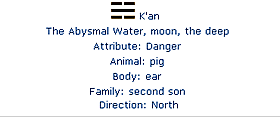
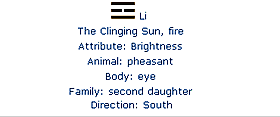
Water over fire: the image of the condition In AFTER COMPLETION. Thus the superior man Takes thought of misfortune And arms himself against it in advance.
When water in a kettle hangs over fire, the two elements stand in relation and thus generate energy (cf. the production of steam). But the resulting tension demands caution. If the water boils over, the fire is extinguished an its energy is lost. If the heat is too great, the water evaporates into the air. These elements here brought in to relation and thus generating energy are by nature hostile to each other. Only the most extreme caution can prevent damage. In life too there are junctures when all forces are in balance and work in harmony, so that everything seems to be in the best of order. In such times only the sage recognizes the moments that bode danger and knows how to banish it by means of timely precautions.
THE LINES
Nine at the beginning means: He breaks his wheels. He gets his tail in the water. No blame.
In times following a great transition, everything is pressing forward, striving in the direction of development and progress. But this pressing forward at the beginning is not good; it overshoots the mark and leads with certainty to loss and collapse. Therefore a man of strong character does not allow himself to be infected by the general intoxication but checks his course in time. He may indeed not remain altogether untouched by the disastrous consequences of the general pressure, but he is hit only from behind like a fox that, having crossed the water, at the last minute gets its tail wet. He will not suffer any real harm, because his behavior has been correct.
 Six in the second place means:
The woman loses the curtain of her carriage.
Do not run after it;
On the seventh day you will get it.
Six in the second place means:
The woman loses the curtain of her carriage.
Do not run after it;
On the seventh day you will get it.
When a woman drove out in her carriage, she had a curtain that hid her from the glances of the curious. It was regarded as a breach of propriety to drive on if this curtain was lost. Applied to public life, this means that a man who wants to achieve something is not receiving that confidence of the authorities which he needs, so to speak, for his personal protection. Especially in times "after completion" it may happen that those who have come to power grow arrogant and conceited and no longer trouble themselves about fostering new talent. This as a rule results in office seeking. If a man's superiors withhold their trust from him, he will seek ways and means of getting it and of drawing attention to himself. We are warned against such an unworthy procedure: "Do not seek it." Do not throw yourself away on the world, but wait tranquilly and develop your personal worth by your own efforts. Times change. When the six stages of the hexagram have passed, the new era dawns. That which is a man's own cannot be permanently lost. It comes to him of its own accord. He need only be able to wait.
Nine in the third place means: The Illustrious Ancestor Disciplines the Devil's Country. After three years he conquers it. Inferior people must not be employed.
"Illustrious Ancestor" is the dynastic title of the Emperor Wu Ting of the Yin dynasty. After putting his realm in order with a strong hand, he waged long colonial wars for the subjection of the Huns who occupied the northern borderland with constant threat of incursions. The situation described is as follows. After times of completion, when a new power has arisen and everything within the country has been set in order, a period of colonial expansion almost inevitably follows. Then as a rule long-drawn-out struggles must be reckoned with. For this reason, a correct colonial policy is especially important. The territory won at such bitter cost must not be regarded as an almshouse for people who in one way or another have hade themselves impossible at home, but who are thought to be quite good enough for the colonies. Such a policy ruins at the outset any chance of success. This holds true in small as well as large matters, because it is not only rising states that carry on a colonial policy; the urge to expand, with its accompanying dangers, is part and parcel of every ambitious undertaking.
Six in the fourth place means: The finest clothes turn to rags. Be careful all day long.
In a time of flowering culture, an occasional convulsion is bound to occur, uncovering a hidden evil within society and at first causing a great sensation. But since the situation is favorable on the whole, such evils can easily be glossed over and concealed from the public. Then everything is forgotten and peace apparently reigns complacently once more. However, to the thoughtful man, such occurrences are grave omens that he does not neglect. This is the only way of averting evil consequences.
Nine in the fifth place means: The neighbor in the east who slaughters an ox Does not attain as much real happiness As the neighbor in the west With his small offering.
Religious attitudes are likewise influenced by the spiritual atmosphere prevailing in times after completion. In divine worship the simple old forms are replaced by an ever more elaborate ritual and an ever greater outward display. But inner seriousness is lacking in this show of magnificence; human caprice takes the place of conscientious obedience to the divine will. However, while man sees what is before his eyes, God looks into the heart. Therefore a simple sacrifice offered with real piety holds a greater blessing than an impressive service without warmth.
Six at the top means: He gets his head in the water. Danger.
Here in conclusion another warning is added. After crossing a stream, a man's head can get into the water only if he is so imprudent as to turn back. As long as he goes forward and does not look back, he escapes this danger. But there is a fascination in standing still and looking back on a peril overcome. However, such vain self-admiration brings misfortune. It leads only to danger, and unless one finally resolves to go forward without pausing, one falls a victim to this danger.